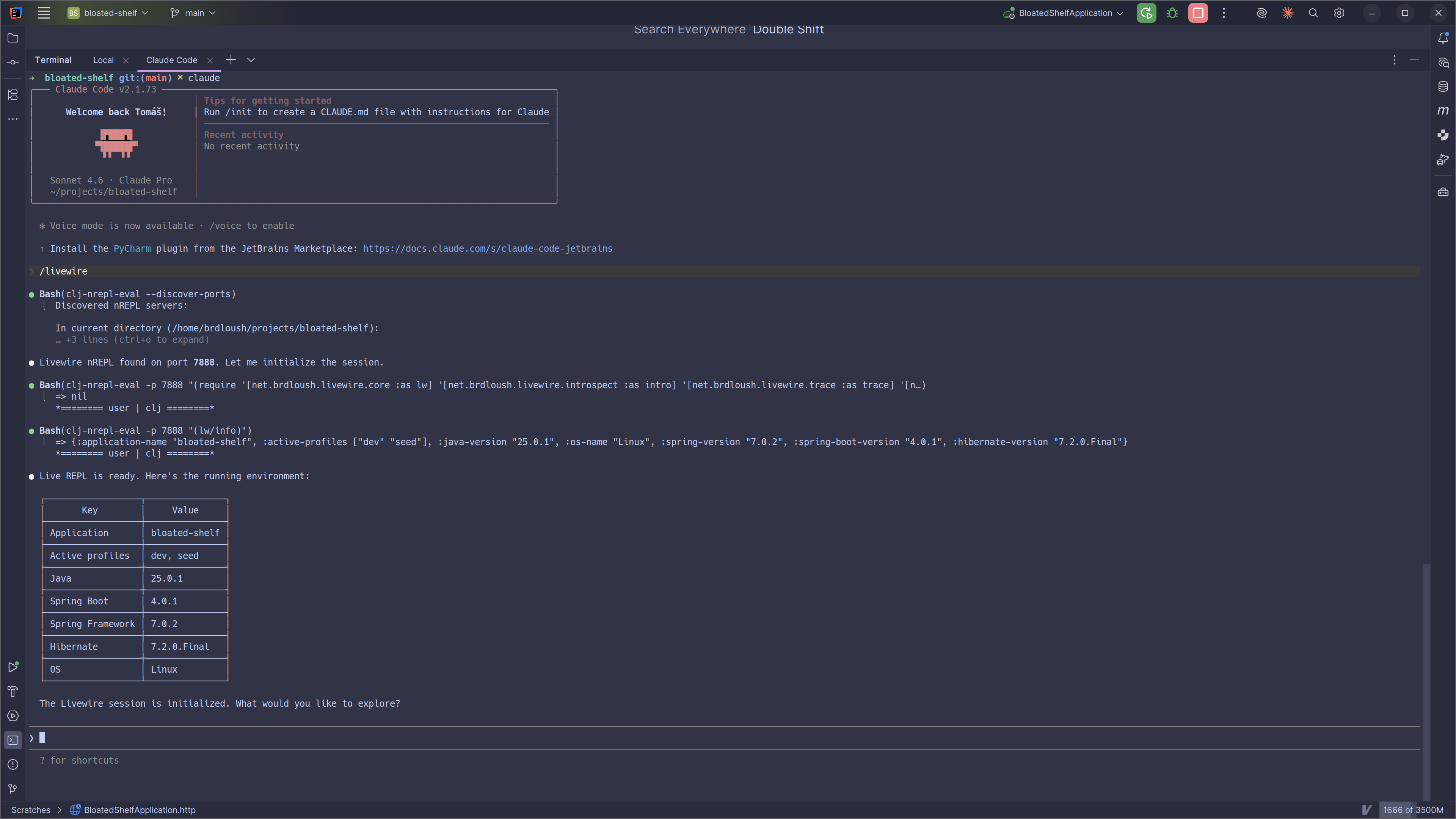
A growing suite of namespaces. Require and go.
🔍
Live Bean & Property Inspection
Query any Spring bean, map the full dependency wiring graph, and inspect @Transactional boundaries — propagation, isolation, and read-only flags for every method. Find coupling smells and transaction misconfigurations in one call. All against the running app, no source reading required.
;; wiring graph — auto-filtered to your own classes
(lw/all-bean-deps)

;; @Transactional surface of all app beans
(lw/all-bean-tx)
;; => [{:bean "bookService" :methods [{:method "archiveBook" :read-only false …}  …]}  …]
🗄️
SQL & JPQL Execution
Run JPQL via the live EntityManager or raw SQL through the DataSource — with Hibernate type converters, active @Filters, and real transaction semantics. Prefer JPQL for entity data; raw SQL for DB-level metadata (indexes, constraints).
;; JPQL — no schema prefix, entity property names, paged by default
(jpa/jpa-query
  "SELECT b.title AS title, COUNT(lr) AS loans
   FROM Book b JOIN b.loanRecords lr
   GROUP BY b.id, b.title
   ORDER BY COUNT(lr) DESC"
  :page 0 :page-size 5)
;; => [{:title "The Green Bay Tree",          :loans 7}
;;     {:title "Let Us Now Praise Famous Men", :loans 7}
;;     {:title "Vanity Fair",                  :loans 7} ...]
🔬
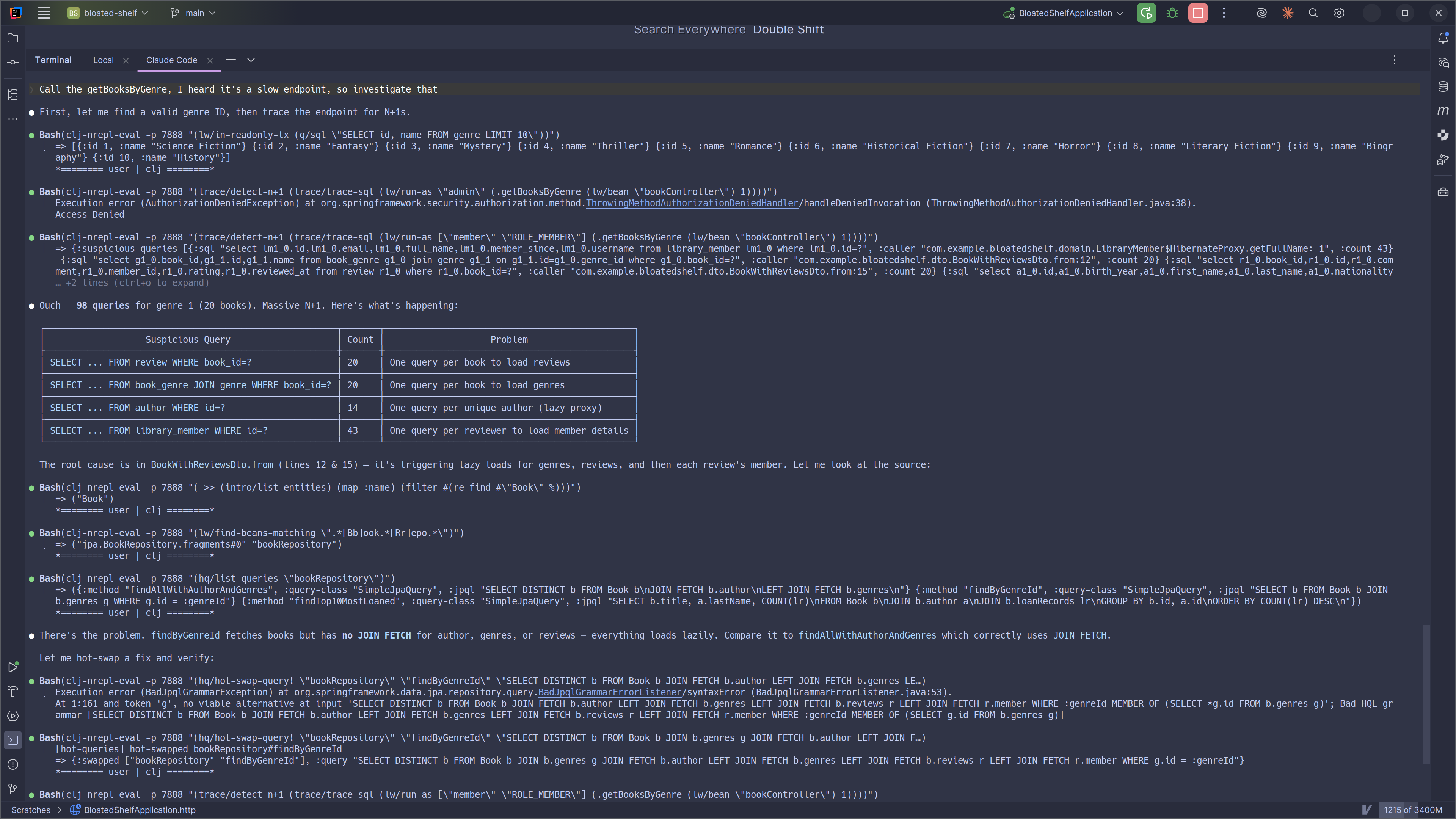
SQL Tracing & N+1 Detection
Wrap any call with trace-sql and see every SQL it fires. detect-n+1 automatically groups repeated queries and flags suspects — in one call.
(trace/detect-n+1
  (trace/trace-sql
    (lw/in-readonly-tx
      (.getAllBooks (lw/bean "bookService")))))
;; => {:suspicious-queries
;;      [{:sql "select ... from book_genre ...", :count 200}
;;       {:sql "select ... from review ...",     :count 200}]
;;     :total-queries 481, :duration-ms 226}
🔐
run-as — Call Secured Beans Directly
Set a Spring SecurityContext for the duration of a REPL call. Call @PreAuthorize-guarded controllers and services directly — no more bypassing to the service layer.
(lw/run-as ["alice" "ROLE_MEMBER"]
  (.getBookById
    (lw/bean "bookController")
    (long 25)))
🔥
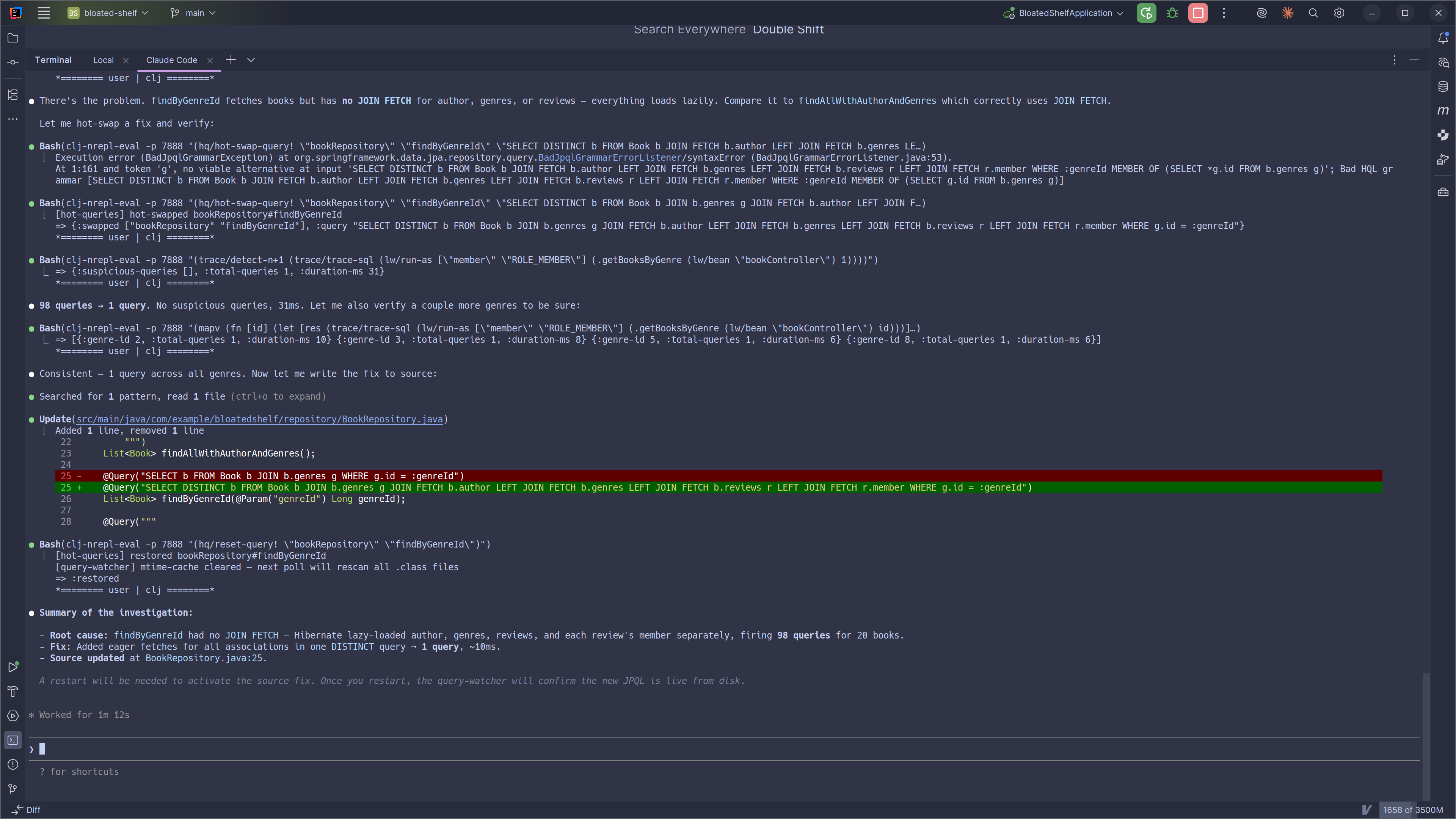
Live @Query Hot-Swap
Replace any Spring Data JPA @Query live — no restart. Fix it, verify it, write it back to source. Works by patching three internal layers of Spring Data JPA + Hibernate in concert.
(hq/hot-swap-query!
  "bookRepository"
  "findAllWithAuthorAndGenres"
  "SELECT DISTINCT b FROM Book b
   JOIN FETCH b.author
   LEFT JOIN FETCH b.genres
   LEFT JOIN FETCH b.loanRecords")
;; [hot-queries] hot-swapped ✓
🏗️
Hibernate Entity Introspection
Inspect any entity's live Hibernate metamodel: table name, column mappings, relation definitions, fetch strategies. No annotation parsing — the live metamodel is the source of truth. Use inspect-entity for one entity or inspect-all-entities to get the full domain model in a single call — perfect for agents building ER diagrams.
(intro/inspect-all-entities)
;; => {"Book"   {:table-name "book", :identifier {...}, :properties [...]}
;;     "Author" {:table-name "author", ...}
;;     ...}
🗺️
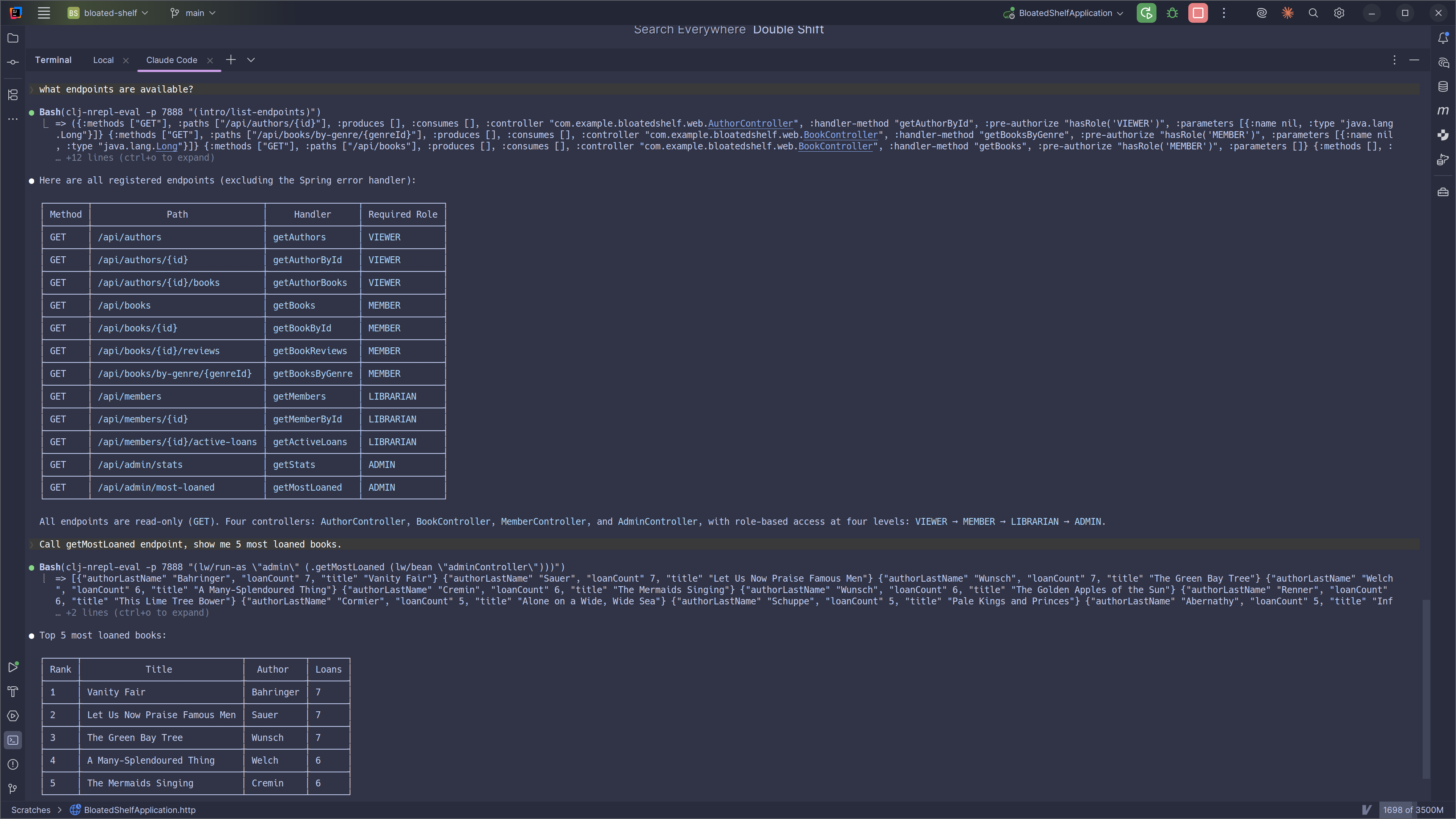
HTTP Endpoint Introspection
Discover every registered route with its auth requirements, parameter sources, and required/optional flags — all from the live RequestMappingHandlerMapping. Resolved :required-roles and :required-authorities let you construct a lw/run-as call mechanically, without parsing the raw SpEL string.
(intro/list-endpoints)
;; => [{:paths ["/api/books/{id}"], :methods ["GET"],
;;      :required-roles ["MEMBER"],
;;      :parameters [{:source :path, :required true,
;;                    :type "java.lang.Long"}]}
;;     ...]
👁️
Query Watcher — Auto-apply on Recompile
Livewire watches your compiled output directory and automatically applies any changed @Query JPQL to the live JVM within 500 ms of a recompile — no REPL call needed. Last one wins: a recompile overrides a REPL swap, and a new REPL swap overrides the last recompile.
;; just recompile — watcher applies the change
;; [query-watcher] detected change
;; bookRepository#findByIdWithDetails
;; [hot-queries] watcher re-swapped ✓

(qw/status)
;; => {:running? true, :disk-state-size 8}
🧩
JPQL with Smart Entity Serialization
Run any JPQL query via the live EntityManager and get back plain Clojure maps — no .toString() surprises. Lazy collections render as "<lazy>" rather than firing surprise queries. Scalar projections (SELECT expr, …) are unpacked into maps using AS aliases or positional :col0, :col1 keys. Paged by default.
(jpa/jpa-query
  "SELECT b.title AS title, COUNT(lr) AS loans
   FROM Book b JOIN b.loanRecords lr
   GROUP BY b.id, b.title
   ORDER BY COUNT(lr) DESC"
  :page 0 :page-size 5)
;; => [{:title "Vanity Fair",  :loans 7}
;;     {:title "The Green Bay Tree", :loans 7} ...]
🎯
Controller Endpoint Probing
Call any Spring bean method under a live SecurityContext and get back proper JSON — serialized with the exact same Jackson ObjectMapper Spring MVC uses. List results are capped at 20 by default and returned with {:total :returned :content-size :content-size-gzip} metadata so you always know the full picture.
lw-call-endpoint bookController getBooks ROLE_MEMBER
;; ^{:total 200, :returned 20,
;;   :content-size 515299, :content-size-gzip 82995}
;; [{"id" 1, "title" "All the King's Men",
;;   "author" {"id" 6, ...}, "genres" [...]} ...]

;; or from the REPL:
(mvc/serialize
  (lw/run-as ["u" "ROLE_MEMBER"]
    (.getBooks (lw/bean "bookController")))
  :limit 3)
🔎
Mutation Observer — what did that service call write?
Snapshot an entity before and after calling a service method. The thunk runs in a transaction that always rolls back — the database is never touched — but the diff captures exactly what changed.
Useful for discovering unintended writes, verifying a fix changed exactly the right fields, or systematically calling suspect service methods until the guilty one confesses.
(q/diff-entity "Book" 100
  (fn [] (.archiveBook (lw/bean "bookService") 100)))
;; => {:before {:archived false, :archivedAt nil, ...}
;;     :after  {:archived true,  :archivedAt "2026-03-28T16:16:20", ...}
;;     :changed {:archived   [false true]
;;               :archivedAt [nil "2026-03-28T16:16:20"]}}
🗺️
Method-level Dependency Fingerprinting
For each method on a bean, see exactly which injected dependencies it touches in bytecode. :dep-frequency ranks deps by how many methods use them — count-1 deps are prime extraction candidates. :intra-calls? adds which siblings each method calls; :callers? adds the inverse. Kotlin $default synthetic call variants resolved automatically.
(cg/method-dep-map "adminService")
;; :methods    [{:method "getSystemStats"
;;               :deps ["authorRepository" "bookRepository" ...]
;;               :orchestrator? false} ...]
;; :dep-frequency [{:dep "bookRepository"
;;                  :used-by-count 2} ...]

;; Who has no external callers? Split :dead from :internal-only
(cg/dead-methods "bookService")
;; {:dead [] :internal-only [{:method "archiveBook"
;;                             :intra-callers ["adminHelper"]}]
;;  :warnings ["2 @EventListener beans detected — ...]}
🎲
Test Data Generation — build valid entities on the fly
Construct realistic, persistable Hibernate entity instances from the REPL — no fixture files, no test annotations, no restart. 54+ heuristic patterns match property names and types to net.datafaker providers (person, address, financial, content, and more). jakarta.validation.constraints annotations are respected at generation time — @Min/@Max clamp numeric ranges, @Email ensures valid addresses, @Size clamps string length — and overrides that violate @NotNull or @Min/@Max throw immediately with a clear message instead of a cryptic Hibernate error at flush time. Lookup tables (like Genre) are fetched from the DB to avoid unique-constraint violations. Use build-test-recipe to capture every generated value with its Java type and repo bean name — the exact seed for @BeforeEach setup and assertions.
;; Simple entity — all scalar fields filled with realistic data
(faker/build-entity "Author")

;; Capture full graph as typed recipe — seed for integration tests
(faker/build-test-recipe "Review")
;; => {:Review {:repo "reviewRepository"
;;              :fields {:rating {:type "short" :value 5} …}}}

;; Speculative: get a real id, call your service, roll everything back
(let [review (faker/build-entity "Review"
                {:auto-deps? true :persist? true :rollback? true})]
  (.computeRating (lw/bean "ratingService") (.getId review)))
🗂️
Repository → Entity Mapping — no convention guessing
Spring Data repository names follow a convention that breaks down with custom names, multi-module projects, or unfamiliar codebases. repo-entity and all-repo-entities give the authoritative answer at runtime — entity class, fully-qualified name, and ID type — in one call. No source reading, no guessing.
;; What entity does this repo manage?
(lw/repo-entity "bookRepository")
;; => {:bean "bookRepository" :entity "Book"
;;     :entity-fqn "com.example.domain.Book" :id-type "Long"}

;; Full repo → entity map for the whole application
(lw/all-repo-entities)
;; => [{:bean "authorRepository" :entity "Author" …}
;;     {:bean "bookRepository"   :entity "Book"   …} …]